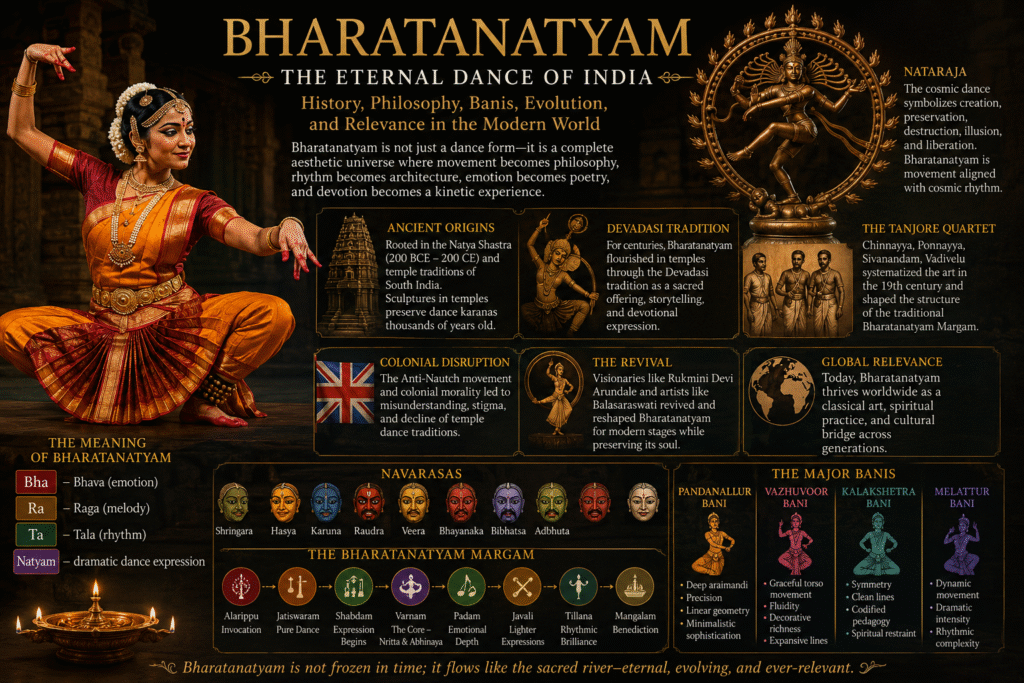
Introduction: More Than a Dance Form
Bharatanatyam is often introduced as one of the oldest classical dance forms of India. While this statement is historically true, it barely captures the immense philosophical, cultural, and artistic depth of the form.
Bharatanatyam is not merely dance.
It is a complete aesthetic universe.
It is movement transformed into philosophy, rhythm transformed into architecture, emotion transformed into poetry, and devotion transformed into kinetic experience.
For more than two thousand years, Bharatanatyam has survived political upheavals, colonial suppression, social transformation, modernization, and globalization. Yet it continues to evolve while preserving its essential grammar and sacred intensity.
Today, Bharatanatyam exists simultaneously as:
- A classical performance tradition
- A spiritual discipline
- A system of embodied knowledge
- A cultural archive
- A sophisticated rhythmic science
- A theatrical language
- A meditative practice
- A global artistic movement
Every aspect of Bharatanatyam reflects precision.
The eyes move with intention. The feet converse with rhythm. The torso creates geometry. The hands become language. The face becomes literature.
To witness a mature Bharatanatyam performance is not simply to watch dance. It is to experience a dialogue between body, rhythm, mythology, music, sculpture, mathematics, and emotion.
And perhaps that is why Bharatanatyam continues to remain profoundly relevant even in the modern world.
The Meaning and Etymology of Bharatanatyam
The word “Bharatanatyam” is often interpreted through a symbolic breakdown:
- Bha — Bhava (emotion)
- Ra — Raga (melody)
- Ta — Tala (rhythm)
- Natyam — dramatic dance expression
Though this interpretation is pedagogical rather than historically ancient, it beautifully expresses the integrated structure of Bharatanatyam
Scholars also connect the term to Bharata Muni, the legendary author of the Natya Shastra — the foundational Sanskrit treatise on Indian dramaturgy and performing arts.
Historically, Bharatanatyam was known by several names, including:
- Sadir
- Dasi Attam
- Chinna Melam
The modern term “Bharatanatyam” gained widespread prominence during the twentieth-century revival movement.
Historical Origins of Bharatanatyam
The Natya Shastra and Ancient Foundations
The philosophical and technical roots of Bharatanatyam are deeply linked to the Natya Shastra, believed to have been composed between approximately 200 BCE and 200 CE.
The Natya Shastra remains one of the most sophisticated artistic treatises ever written. It systematically codifies:
- Movement
- Gesture
- Rhythm
- Music
- Stagecraft
- Emotional theory
- Costume
- Dramatic structure
- Aesthetic philosophy
The text conceptualizes performance not merely as entertainment but as a sacred medium capable of elevating human consciousness.
Central concepts from the Natya Shastra continue to define Bharatanatyam today:
- Rasa (aesthetic emotional experience)
- Bhava (emotion)
- Abhinaya (expression)
- Angika (body movement)
- Tala (rhythm)
- Nritta, Nritya, and Natya
The relationship between sculpture and dance is also deeply important.
Temple architecture across South India preserves numerous dance postures remarkably similar to Bharatanatyam technique. Temples such as:
- Brihadeeswara Temple
- Chidambaram Nataraja Temple
- Belur Temple
- Halebidu Temple
contain sculptural representations of dance karanas and movement principles described in the Natya Shastra.
These temples functioned not merely as religious centers but also as major artistic institutions.
Bharatanatyam and the Devadasi Tradition
For centuries, Bharatanatyam flourished within South Indian temple traditions through the Devadasi system.
Devadasis were women dedicated to temple service and were among the most highly trained artists of their time. Their education included:
- Dance
- Music
- Poetry
- Literature
- Sanskrit
- Regional languages
- Ritual knowledge
- Aesthetic interpretation
Their performances were not conceived as commercial entertainment.
Dance functioned as:
- Ritual offering
- Devotional expression
- Sacred storytelling
- Spiritual communication
- Cultural preservation
The emotional landscape of Bharatanatyam during this period was heavily influenced by Bhakti traditions, especially Shaivism and Vaishnavism.
The dancer’s relationship with the divine was often expressed through the language of longing, surrender, love, separation, and union.
This period produced some of the most refined artistic lineages in Indian cultural history.
The Tanjore Quartet and the Codification of Bharatanatyam
The modern pedagogical structure of Bharatanatyam owes enormous debt to the Tanjore Quartet:
- Chinnayya
- Ponnayya
- Sivanandam
- Vadivelu
Working in the nineteenth century under the patronage of Serfoji II of Thanjavur, they systematized Bharatanatyam into a highly structured performance format.
Their contributions include:
- Codification of Adavus
- Structuring the Margam
- Refinement of rhythmic compositions
- Integration of Carnatic music structures
- Development of performance sequencing
The traditional Bharatanatyam Margam still performed today is largely shaped by their vision.
Colonial Disruption and the Anti-Nautch Movement
The colonial era marked one of the most difficult periods in Bharatanatyam’s history.
British Victorian morality misunderstood hereditary performance traditions and increasingly associated them with social stigma.
The Anti-Nautch movement of the late nineteenth and early twentieth centuries severely damaged temple dance traditions.
As a result:
- Patronage declined
- Hereditary artists lost institutional support
- Temple traditions weakened
- Bharatanatyam faced near extinction
Modern scholarship increasingly recognizes that colonial narratives often erased the artistic sophistication and cultural significance of hereditary performers.
Understanding Bharatanatyam’s history therefore requires acknowledging both artistic brilliance and historical complexity.
The Revival of Bharatanatyam
The twentieth century witnessed a remarkable cultural revival that restored Bharatanatyam to national and international visibility.
Among the most important revivalists was Rukmini Devi Arundale, founder of Kalakshetra Foundation.
Her contributions included:
- Institutionalizing Bharatanatyam pedagogy
- Refining costume aesthetics
- Presenting Bharatanatyam on proscenium stages
- Emphasizing geometric precision and spiritual refinement
Equally significant was Balasaraswati, who represented the hereditary artistic lineage andemphasized:
- Musical immersion
- Emotional subtlety
- Improvisational depth
- Abhinaya sophistication
The artistic dialogue between these two approaches deeply shaped modern Bharatanatyam.
Other major contributors include:
- E. Krishna Iyer
- Yamini Krishnamurthy
- Padma Subrahmanyam
- Alarmel Valli
- Leela Samson
- Malavika Sarukkai
Each artist expanded Bharatanatyam in unique ways while preserving its classical integrity.
Rasa Theory
The objective of Bharatanatyam is not merely to display technical brilliance.
Its deeper purpose is the evocation of Rasa — the aesthetic experience felt by the audience.
The Navarasas include:
- Shringara — love
- Hasya — humor
- Karuna — compassion
- Raudra — anger
- Veera — heroism
- Bhayanaka — fear
- Bibhatsa — disgust
- Adbhuta — wonder
- Shanta — peace
A great Bharatanatyam dancer does not merely enact emotions. They transform emotion into aesthetic experience.
Nataraja: The Cosmic Dancer
The image of Shiva as Nataraja is central to Bharatanatyam philosophy.
Nataraja symbolizes:
- Creation
- Preservation
- Destruction
- Illusion
- Liberation
The cosmic dance becomes a metaphor for existence itself.
Thus, Bharatanatyam is not merely human movement. It is movement aligned with cosmic rhythm.
Technical Structure of Bharatanatyam
Bharatanatyam is one of the most rigorously codified movement systems in the world.
It integrates:
Nritta
Pure dance emphasizing rhythm, geometry, and movement.
Nritya
Expressive dance combining rhythm with storytelling and emotional interpretation.
Natya
Dramatic theatrical representation.
The form incorporates:
- Adavus
- Hastas
- Bhedas
- Mandalas
- Karanas
- Jatis
- Korvais
- Abhinaya
- Tala systems
- Rhythmic mathematics
Its movement vocabulary demands:
- Precision
- Balance
- Endurance
- Rhythm consciousness
- Spatial intelligence
- Emotional sensitivity
The Bharatanatyam Margam
The traditional Margam represents a carefully designed artistic journey.
Alarippu
A rhythmic invocatory piece opening the dancer’s body and consciousness.
Jatiswaram
Pure dance exploring melody and rhythm.
Shabdam
Introduction of narrative and expressive interpretation.
Varnam
The centerpiece of Bharatanatyam combining intense Nritta and profound Abhinaya.
Padam
Emotionally nuanced compositions emphasizing subtle expression.
Javali
Lighter romantic compositions.
Tillana
A brilliant rhythmic finale.
Mangalam
A concluding benediction.
The Margam is often compared to the spiritual and emotional unfolding of a complete human journey.
The Major Banis of Bharatanatyam
A Bani is not merely a style.
It is an artistic philosophy.
Each Bani reflects different approaches to:
- Geometry
- Rhythm
- Expression
- Energy
- Musicality
- Movement quality
- Pedagogy
Pandanallur Bani
Known for:
- Deep araimandi
- Precision
- Linear geometry
- Restrained elegance
- Minimalistic sophistication
This Bani emphasizes clarity, discipline, and structural purity.
Vazhuvoor Bani
Known for:
- Graceful torso movement
- Fluidity
- Sweeping lines
- Decorative richness
- Expansive stage presence
This style is lyrical, visually elaborate, and highly theatrical.
Kalakshetra Bani
Developed through the institutional vision of Rukmini Devi Arundale.
Known for:
- Symmetry
- Clean lines
- Codified pedagogy
- Spiritual restraint
- Refined group choreography
The Kalakshetra style is architectural, disciplined, and aesthetically meditative.
Melattur Bani
Known for:
- Dynamic movement
- Dramatic intensity
- Rhythmic complexity
- Brisk transitions
- Strong theatrical quality