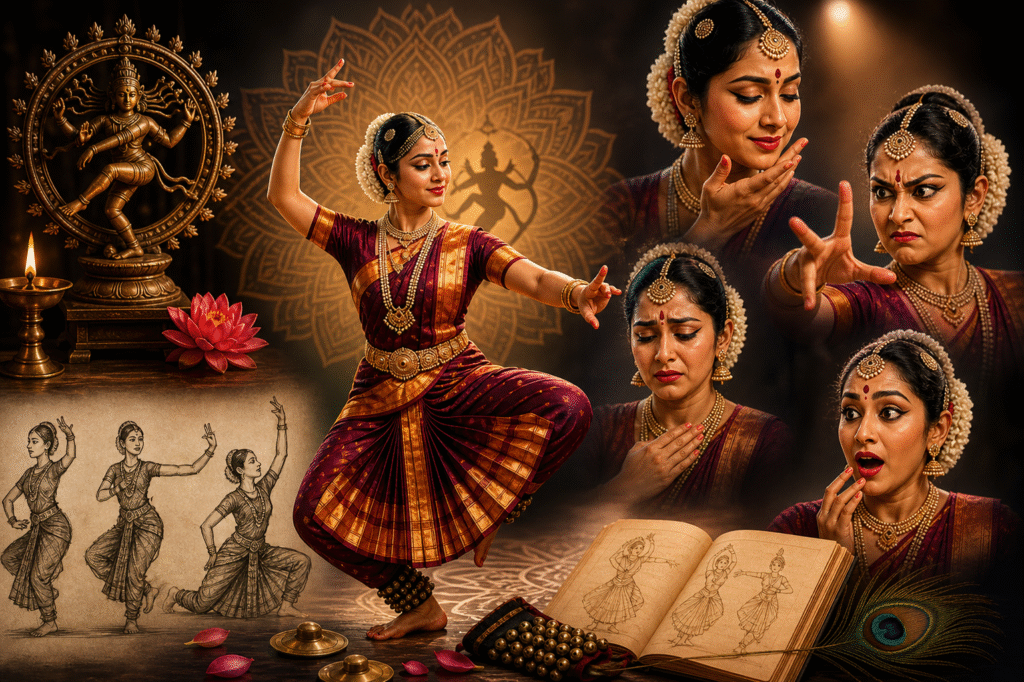
1. Introduction: What is Rasa?
The term Rasa (Sanskrit: “essence,” “flavour,” or “relish”) is the core aesthetic principle of Indian performing arts. It originates from the Natya Shastra by Bharata Muni, which defines Rasa as:
“That which is relished by the audience.”Rasa is not simply emotion—it is the transformed, aesthetic experience of emotion that arises in the spectator through performance.
2. The Rasa Sutra (Foundational Formula)
The famous Rasa Sutra explains how Rasa is generated:
Vibhava + Anubhava + Vyabhichari Bhava → Rasa
Components:
- Vibhava (Determinants) – Cause or stimulus (situation, characters)
- Anubhava (Consequents) – Physical expressions (facial, bodily reactions)
- Vyabhichari Bhavas (Transient emotions) – Supporting fleeting feelings
- Sthayi Bhava (Permanent emotion) – The dominant emotion within the performer
When these combine effectively, the audience experiences Rasa.
3. The Eight Classical Rasas (Ashta Rasas)
Originally, Bharata Muni described eight Rasas, each derived from a Sthayi Bhava. These are fundamental to Bharatanatyam’s expressive dimension (Abhinaya).
1. Śṛṅgāra Rasa (The Erotic / Love)
- Sthayi Bhava: Rati (love)
- Color: Dark blue or green
- Deity: Vishnu / Kamadeva
Śṛṅgāra is considered the king of Rasas. It includes:
- Sambhoga (union) – love fulfilled
- Vipralambha (separation) – longing and विरह
In Bharatanatyam, it is central to Padams and Javalis, especially in Nayika–Nayaka dynamics.
2. Hāsya Rasa (The Comic)
- Sthayi Bhava: Hasa (laughter)
- Color: White
- Deity: Pramatha
Expressed through:
- Smiles, gentle laughter, satire
- Can range from subtle amusement to exaggerated humor
3. Karuṇa Rasa (The Pathetic / Compassion)
- Sthayi Bhava: Shoka (sorrow)
- Color: Grey
- Deity: Yama
Evokes:
- Grief, empathy, helplessness
- Seen in narratives of separation, loss, or devotion
4. Raudra Rasa (The Furious)
- Sthayi Bhava: Krodha (anger)
- Color: Red
- Deity: Rudra (Shiva)
Characterized by:
- Aggression, intensity
- Often depicted in mythological battles
5. Vīra Rasa (The Heroic)
- Sthayi Bhava: Utsaha (courage)
- Color: Golden
- Deity: Indra
Subtypes include:
- Dharma Vira (righteous courage)
- Yuddha Vira (martial valor)
6. Bhayānaka Rasa (The Terrible / Fear)
- Sthayi Bhava: Bhaya (fear)
- Color: Black
- Deity: Kala (Time / Death)
Expressed through:
- Trembling, anxiety, anticipation of danger
7. Bībhatsa Rasa (The Odious / Disgust)
- Sthayi Bhava: Jugupsa (aversion)
- Color: Blue
- Deity: Mahakala
Depicts:
- Disgust, moral repulsion, rejection
8. Adbhuta Rasa (The Marvelous / Wonder)
- Sthayi Bhava: Vismaya (astonishment)
- Color: Yellow
- Deity: Brahma
Evokes:
- Awe, curiosity, fascination
4. The Ninth Rasa: Śānta Rasa (The Tranquil)
Śānta Rasa was not included in the original eight but was later introduced and philosophically established by scholars such as Abhinavagupta.
Śānta Rasa (Peace / Tranquility)
- Sthayi Bhava: Shama (inner peace, detachment)
- Color: Crystal white
- Deity: Narayana / Buddha (varies by tradition)
Śānta represents:
- Spiritual stillness
- Detachment from worldly desires
- Ultimate aesthetic resolution
In Bharatanatyam, it is often experienced in:
- Devotional pieces
- Concluding moments of performance
- Meditative stillness after emotional culmination
5. Rasa in Bharatanatyam Practice
In Bharatanatyam, Rasas are expressed through:
a. Abhinaya (Expression System)
- Angika – Body movements
- Vachika – Spoken/lyrical expression
- Aharya – Costume and makeup
- Satvika – Internal emotional truth
b. Facial Micro-Expressions
- Eyes (Drishti bheda)
- Eyebrows (Bhrukuti)
- Lips and cheeks
c. Body Language
- Posture shifts
- Energy modulation
6. The Interplay of Bhava and Rasa
A critical distinction:
- Bhava = Emotion enacted by the dancer
- Rasa = Emotion experienced by the audience
Thus:The dancer performs Bhava, but the audience relishes Rasa.
7. Combinational Use of Rasas
Rasas rarely exist in isolation. A single piece may include:
- Śṛṅgāra → Karuṇa → Vīra
- Bhayānaka → Adbhuta
- Raudra → Vīra
This layering creates emotional depth and narrative richness.
8. Mathematical and Structural Precision in Rasa
Though Rasas seem emotional, they are highly structured:
- Each Rasa has codified expressions
- Each Bhava is linked to:
- Specific eye movements
- Defined facial muscles
- Transitions must follow logical emotional progression
Thus, Rasa is:
Emotion disciplined by technique
9. Philosophical Depth
According to Abhinavagupta:
- Rasa is a universalized emotion
- The spectator transcends personal identity
Experiences a higher aesthetic bliss (Ananda)
10. Importance of Rasa in a Dancer’s Journey
Without Rasa:
- Dance becomes mechanical
- Technique lacks emotional resonance
With Rasa:
- Movement gains meaning
- Performance becomes transformative
11. Conclusion
Rasas are the soul of Bharatanatyam, just as Adavus are its body.
They transform:
- Technique → Expression
- Movement → Meaning
- Performance → Experience
Ultimately:
A true Bharatanatyam dancer does not just perform Rasas—
they evoke them, transmit them, and allow the audience to live them.