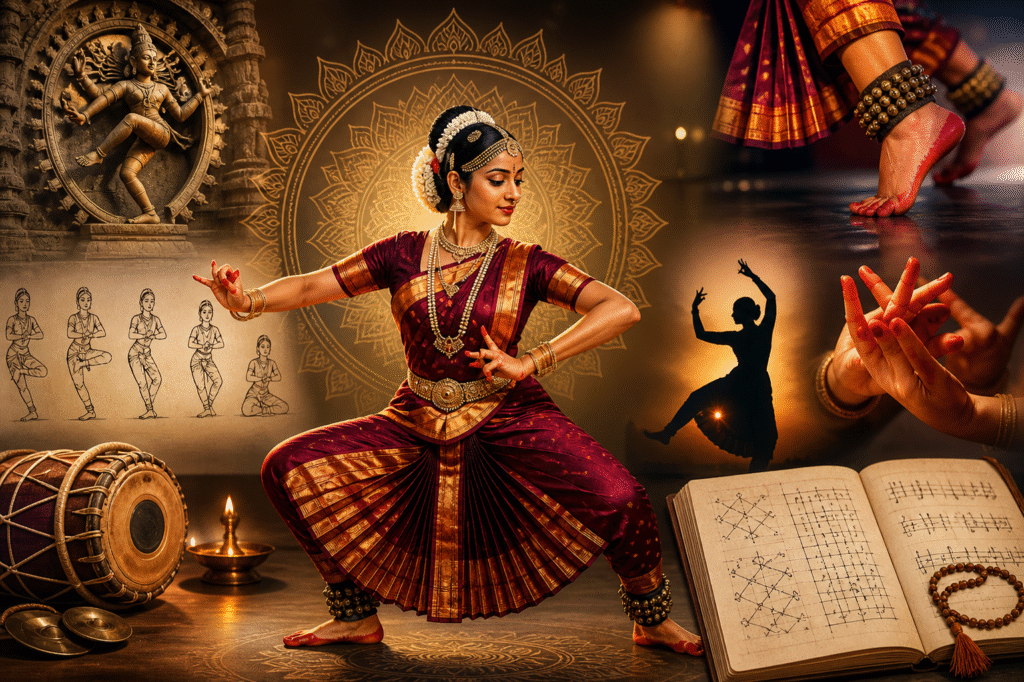
1. Introduction: What is an Adavu?
In Bharatanatyam, the term Adavu (derived from the Tamil root “adu”, meaning “to strike” or “to dance”) refers to the basic unit of pure dance (Nritta). It is not merely a “step,” but a codified kinetic unit, integrating:
- Sthanaka (stance / leg position)
- Mandala (posture / body geometry)
- Chari (movement pathway)
- Hasta / Nritta Hastas (hand gestures)
- Sollukattu (rhythmic syllables)
All of these are executed in perfect synchronisation with Tala (rhythm).
Thus, an Adavu is best understood as the atomic grammar of Bharatanatyam movement, comparable to alphabets in language.
2. Historical Evolution of Adavus
- The conceptual precursor of Adavus lies in the Karana system described in the Natya Shastra.
- However, the term Adavu itself appears later in texts such as:
- Mahabharata Chudamani
- Sangeetha Saramritha by Tulaja
Adavus evolved as pedagogical units—simplifying complex Karanas into teachable modules.
3. Structural Anatomy of an Adavu
Every Adavu is governed by four essential components:
- Sthanaka – Starting and ending position
- Chari – Movement of limbs
- Hasta Kshetra – Spatial pathway of hands
- Nritta Hasta – Decorative hand gestures
Additionally, each Adavu:
- Begins on the right side and concludes on the left
- Is structured in metrical syllables (e.g., tai ya tai hi)
- Exists in three speeds (Kala):
- Vilamba (slow)
- Madhyama (medium)
- Druta (fast)
4. Why Adavus Are Practiced
Adavus are not mechanical drills—they are embodied technique training systems.
They develop:
- Rhythmic precision (Laya control)
- Anga Shuddham (clarity of lines)
- Muscular endurance and stamina
- Balance and spatial awareness
- Coordination between limbs
- Stage geometry and symmetry
In essence, Adavus transform the body into a rhythmic instrument.
5. Classification of Adavus
There is no single universal classification, as traditions vary across banis (schools). However, most systems organize Adavus into 10–20 major groups, each containing multiple variations.
A classical pedagogical structure recognizes:
Core Adavu Groups (Widely Accepted)
- Tatta Adavu – Flat stamping (foundation of rhythm)
- Natta Adavu – Extension with heel lifts
- Visharu / Mardita / Paraval Adavu – Circular spreading movements
- Tattimetti Adavu – Combined stamping and heel work
- Kudittu Mettu Adavu – Jump + heel strike
- Mandi Adavu – Knee-based floor work
- Sarikal Adavu – Sliding / gliding movements
- Teermanam Adavu – Concluding rhythmic patterns
- Jati Adavu – Complex rhythmic sequences
- Murka Adavu – Angular directional patterns
- Tirumanam Adavu – Structured finishing patterns
- Paichal Adavu – Leaping movements
- Kuttita Mettu Adavu – Stamped + lifted accents
- Korvai Adavu – Combination sequences
- Tai Tat Tei Tam Adavu patterns (syllabic variations)
Different schools may rename or regroup these, but the movement principles remain consistent.
6. Complete Naming Tradition (Expanded List)
Across lineages, the following names are encountered:
- Tatta
- Natta
- Metta / Mettadavu
- Kudittu Mettu
- Tattimetti
- Visharu (Paraval / Mardita)
- Mandi
- Sarikal
- Teermanam
- Jati
- Murka
- Tirumanam
- Paichal
- Kuttita Mettu
- Korvai Adavu
- Tai Ha Tai Hi patterns
- Tari Tai Tam patterns
👉 Important note:
There is no single canonical “complete list” because:
- Each bani (Kalakshetra, Pandanallur, Vazhuvoor, etc.) modifies grouping
- Some count 10 major classes, each with ~12 variations → ~120 units
- Others teach 60+ individual Adavus
7. Variations Within Each Adavu
Each Adavu group contains multiple variations, typically:
- 4, 6, 8, or 12 variations per group
- Structured according to:
- Direction (right/left/diagonal)
- Level (araimandi/full mandi)
- Rhythm (3-beat, 4-beat, 5-beat cycles)
- Spatial expansion
Example:
Tatta Adavu Variations:
- 1st: Alternate stamping
- 2nd: Double stamping
- 3rd: Cross-pattern stamping
- 4th: Rhythmic subdivisions
8. Mathematical Framework of Adavus
Bharatanatyam is deeply mathematical. Adavus operate within:
a. Tala Structure
- Adavus align with Adi Tala (8 beats) or other talas
- Each step corresponds to aksharas (beats)
b. Sollukattu Patterns
Examples:
- Tai Ya Tai Hi
- Tai Dhit Tai
- Ta Ka Dhi Mi
These define:
- Beat distribution
- Movement accents
c. Speed Multiplication
Same Adavu performed in:
- 1st speed → 1 unit per beat
- 2nd speed → 2 units per beat
- 3rd speed → 4 units per beat
d. Symmetry
- Right–left balance
- Geometric floor patterns
9. Combinations: From Adavu to Dance
Adavus combine into:
a. Korvai
- Structured sequence of Adavus
- Repeated patterns with mathematical endings
b. Jati
- Rhythmic composition using Adavus
- Complex calculations and accents
c. Nritta Sequences
Used in:
- Alarippu
- Jatiswaram
- Tillana
Thus:
Adavu → Korvai → Jati → Full choreography
10. Pedagogical Importance
Adavus are practiced daily because:
- They build muscle memory
- Ensure precision before expression (Nritya)
- Establish discipline of body and rhythm
Without mastery of Adavus:
Expression becomes weak, and choreography loses structural integrity.
11. Philosophical Insight
At an advanced level, Adavus are not just technique—they are:
- Embodied rhythm (Tala in motion)
- Geometry in space
- Meditative repetition leading to control
They represent the transformation of the dancer from:
Body → Instrument → Medium of art
12. Conclusion
Adavus are the foundation, framework, and philosophy of Bharatanatyam.
They are:
- The grammar of movement
- The mathematics of rhythm
- The discipline of the dancer’s body
Mastery of Adavus is not optional—it is the very definition of technical excellence in Bharatanatyam.